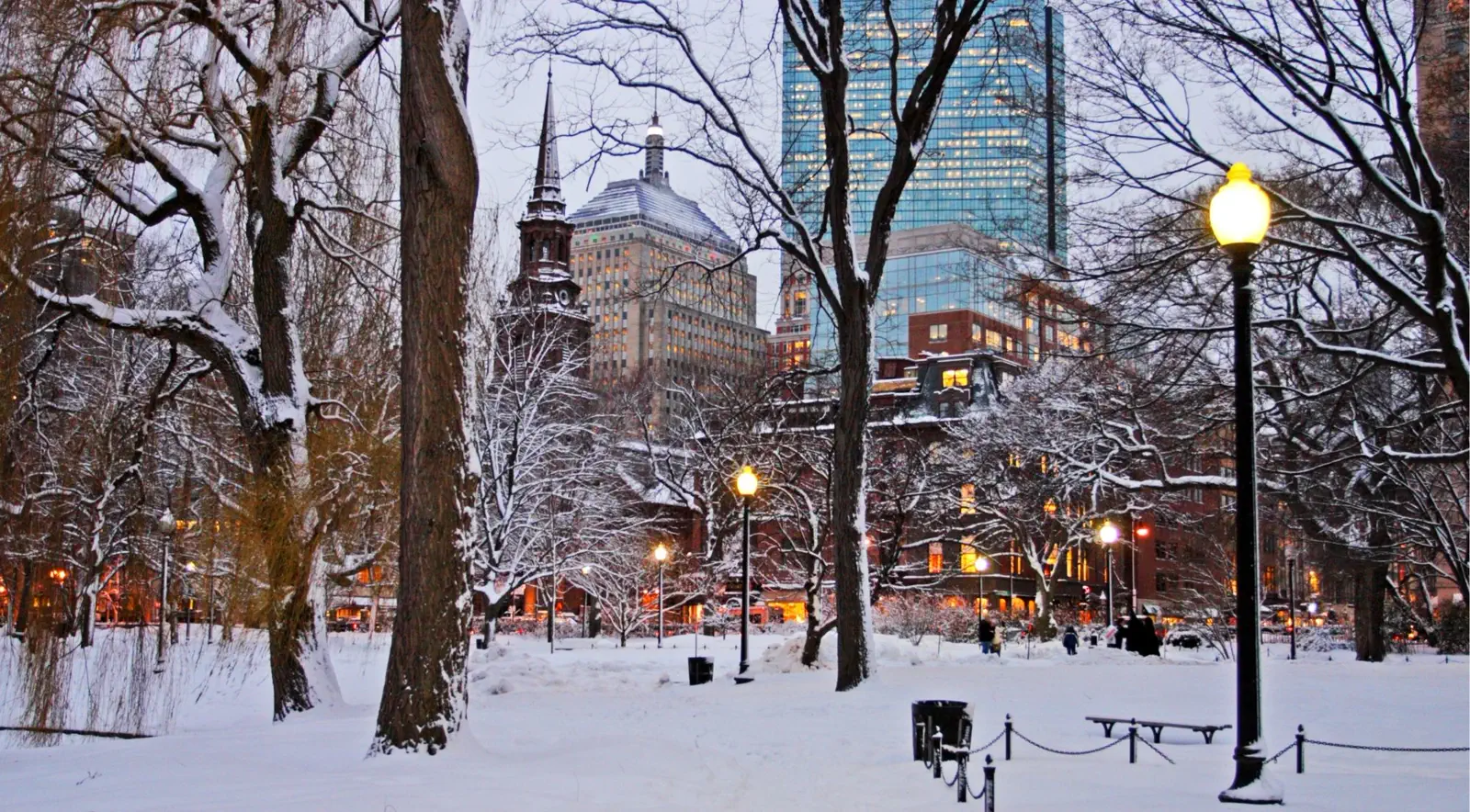
- 4 groundsHistoric burying grounds downtown
- 1630King's Chapel, Boston Proper's oldest
- 9am–4pmAbout, daily; free entry
- 2 of 3Grounds entered at night on Ghosts & Gravestones
- From $47Ghosts & Gravestones, 90 min
Talking About a Graveyard Is Not the Same as Going In
Boston is unusually good for a night in the graveyards. The historic center holds several burying grounds from the 1600s, including King's Chapel, Copp's Hill and Granary, right among the streets most first-time visitors already walk on the Freedom Trail. For most visitors, the tour to book is the Ghosts & Gravestones Trolley Tour, which advertises exclusive nighttime access to two of Boston's oldest burying grounds.
There is an important difference between:
- a Boston ghost tour that talks about graveyards
- a tour that stops outside a burial ground after dark
- a tour that actually takes you inside after normal closing hours
If going inside is the reason you're booking, that difference matters more than the star rating. The history is real too: the people buried here include signers of the Declaration of Independence, the victims of the Boston Massacre, a man whose gravestone still bears musket-ball marks from British soldiers, and thousands of ordinary Bostonians whose graves were robbed for anatomy classes.
Which Boston Graveyard Tour Should You Book?
Three tours cover almost everyone: one to ride, one to walk, and one cheaper walk that stays outside the gates.
Ghosts & Gravestones Trolley Tour
The operator says the tour has exclusive nighttime access into two of Boston's three oldest burying grounds, and its FAQ names the three as Copp's Hill, King's Chapel and Granary. The GetYourGuide and Viator listings name Copp's Hill and Granary, but the pair can vary, so we wouldn't promise two particular cemeteries for every departure. From $47, 4.5 from 717 reviews on GetYourGuide.
Ghosts & Gravestones Nightwalk
For visitors who want to walk, not ride. The operator describes the Nightwalk as a seasonal 90-minute walking tour with exclusive after-hours access to some of Boston's most haunted sites, and its GetYourGuide listing says it includes night-time access into two of the city's oldest burying grounds. On sale on selected nights through October 31, 2026, from $33.
Gravestones & Gunpowder
Despite the name, this isn't the tour to choose if going into a cemetery is your priority: its Viator itinerary lists Granary Burying Ground as a pass-by stop. It's a good, cheaper hour of ghost stories on foot around central Boston, from $27. If what you want to know is "which Boston ghost tour actually goes inside a graveyard?", the answer is Ghosts & Gravestones.
| Tour on GetYourGuide | Inside a burying ground after dark? | Format | From | Length | Rating |
|---|---|---|---|---|---|
| Ghosts & Gravestones | Yes, two of three | Trolley + 2 walks of ~20 min | $47 | 90 min | 4.5 (717) |
| Ghosts & Gravestones Nightwalk | Yes, per its GetYourGuide listing | Walking, seasonal | $33 | 90 min | 4.6 (6) |
| Gravestones & Gunpowder | No, Granary is a pass-by | Walking | $27 | 1 hour | 4.4 (210) |
Prices are GetYourGuide's per-person "from" prices; ratings and review counts are GetYourGuide's, checked October 3, 2026. The Nightwalk has only six GetYourGuide reviews so far, although its Viator listing has 42 averaging 4.9. All three have free cancellation up to 24 hours before.
Other Experiences You Might Enjoy
Visitors who explore Boston's burying grounds often pair them with a Freedom Trail walking tour past Granary and King's Chapel by day, a haunted pub crawl through the city's oldest taverns, a Boston Harbor ghost cruise, or a Salem witch-trial day trip from Boston, with live availability and prices below.
Why Nighttime Cemetery Access Matters in Boston
Boston's historic burying grounds aren't open all night. The City of Boston lists them as open daily from about 9 a.m. to 4 p.m., including:
- Granary Burying Ground
- King's Chapel Burying Ground
- Copp's Hill Burying Ground
- Central Burying Ground
So you can't finish dinner at 7 p.m. and wander into Granary or Copp's Hill on your own. By day you can visit any of them independently and for free; after dark, access is a different matter.
That is the main reason a graveyard night tour offers something a self-guided walk can't. You aren't only paying someone to tell ghost stories. You're paying for an organized evening that includes time inside historic burial grounds after their public hours.
What does "exclusive nighttime access" actually mean?
During the day, Boston's major burying grounds are public historic sites, and you can walk into Granary or Copp's Hill without buying anything. At night the gates aren't simply left open for sightseeing. Ghosts & Gravestones has arranged access that lets its guests into historic burial grounds after normal opening hours. That access is what you're paying for.
So if you're wondering "why pay for a cemetery tour if Granary Burying Ground is free?", the answer is that you don't need a tour to see Granary in daytime hours. You do need one if you want a guided visit inside a burying ground after it has closed.
The Four Historic Burying Grounds, and Which Night Tour Reaches Each
What is buried in each, when it is open, and whether you can get inside after dark.
-
Granary Burying Ground
Established 1660 · Tremont Street, downtown · Open about 9 a.m.–4 p.m.
Granary is probably the Boston graveyard first-time visitors recognize. It sits directly on the Freedom Trail, and the people buried here include:
- Paul Revere
- Samuel Adams
- John Hancock
- Robert Treat Paine
- the five victims of the Boston Massacre: Crispus Attucks, Samuel Gray, James Caldwell, Samuel Maverick and Patrick Carr
- members of Benjamin Franklin's family
The City of Boston counts roughly 2,345 gravestones and tombs, but estimates that more than 5,000 people are buried here. That gap alone shows how crowded these old urban burying grounds are. Many stones no longer mark the graves beneath them: the ground was rearranged more than once, stones were moved into tidier rows, and body snatchers took remains for anatomy classes in the late 18th and early 19th centuries.
Can you visit Granary at night? Not as an independent visitor once the gates have closed. That's why it matters whether a tour merely stops outside Granary or has after-hours access. The Ghosts & Gravestones operator says its night route uses two of Boston's three oldest burying grounds, which may include Granary, and the booking listings name it. If you want to step into a historic Boston burying ground after dark, check Ghosts & Gravestones availability; if Granary specifically is essential, also see it by day.
-
Copp's Hill Burying Ground
Established 1659 · North End · Open about 9 a.m.–4 p.m.
For a ghost tour, Copp's Hill is arguably even better than Granary. The City of Boston calls it the final resting place of more than 10,000 people, and it has a particularly atmospheric setting on the North End's hill. Its height above the harbor gave it military importance in the Revolution: the British set up a battery and earthworks on its southwest side, from which they shelled Bunker Hill and set fire to Charlestown.
Generations of craftspeople, merchants and early Bostonians lie here, and the old slate stones are exactly what many visitors picture when they imagine a colonial New England graveyard. The northern slope holds the burials of Boston's early Black community, many in plain fieldstone graves, and Prince Hall, anti-slavery activist and founder of the Black Masonic order, is buried here. British soldiers occupying the city are said to have used the stones for target practice; the gravestone of Captain Daniel Malcom still carries the marks. His epitaph calls him "a true son of liberty, a friend to the publick, an enemy to oppression". Cotton Mather, the Puritan minister tied to the Salem witch trials, is buried here in the Mather family tomb.
Can you enter Copp's Hill at night? Normally no. Ghosts & Gravestones, though, lists Copp's Hill among the burying grounds it may use with its nighttime access, and Copp's Hill is highlighted in the tour's current GetYourGuide and Viator descriptions, which makes it the tour to book if you're looking for a Copp's Hill ghost tour.
-
King's Chapel Burying Ground
Established 1630 · Tremont Street · Open about 9 a.m.–4 p.m.
King's Chapel Burying Ground is Boston Proper's oldest burying place. Despite the name, it has always been under municipal control, not the church's. Isaac Johnson, who owned the land, is traditionally its first burial, in 1630. Among those buried here are:
- John Winthrop, first governor of the Massachusetts Bay Colony
- Reverend John Cotton
- Mary Chilton, believed to be the first woman off the Mayflower
- early colonial printers, merchants and residents, including the printer Hezekiah Usher
William Dawes, who rode out with Paul Revere in 1775, was buried here too, before being moved to Forest Hills Cemetery. It's one of the most historically interesting graveyards in central Boston, directly on the Freedom Trail, and for many visitors the most unsettling of the three after dark, with the 1688 chapel beside it and narrow streets around it.
Which night tour includes King's Chapel? The Ghosts & Gravestones operator lists King's Chapel as one of the three burying grounds from which each night's two after-hours visits are drawn. Again, it isn't guaranteed on every departure. The accurate way to put it: Ghosts & Gravestones has nighttime access to two historic burying grounds, chosen from Copp's Hill, King's Chapel and Granary.
-
Central Burying Ground
Established 1756 · Boston Common, Boylston Street · Open about 9 a.m.–4 p.m.
Central gets less attention than Granary, King's Chapel and Copp's Hill, but it's another historic cemetery worth knowing about if you're interested in Boston's graveyards. The people buried here reflect a broader cross-section of colonial and early American Boston, including:
- Gilbert Stuart, painter of the George Washington portrait used on the one-dollar bill
- 14 participants in the Boston Tea Party, according to the City of Boston
- Black Bostonians, both free and enslaved
- immigrants, and "strangers" who died in Boston far from home
British officers from Bunker Hill may also be buried here, although the city says this is unconfirmed. Central has the death's-head, cherub and urn-and-willow carvings that make New England gravestones fascinating even if you have no interest in ghosts.
Is there a night tour of Central? Not one we'd build an evening around. It isn't a Freedom Trail stop and isn't among the Ghosts & Gravestones grounds; the night tours are clearly tied to Granary, Copp's Hill and King's Chapel. Walk in from the Boylston Street side of the Common during the day and give it ten minutes.
Ghosts & Gravestones: The Tour That Takes You Inside
The trolley leaves from Old Town Trolley stop #1, at the end of the Marriott Long Wharf Hotel, 200 Atlantic Avenue, nightly from 6 p.m. Your host is a costumed 17th-century gravedigger. The ride takes you through downtown Boston, past streets tied to the Boston Strangler and the city's darker history, and you get off for two walking sections of about 20 minutes each inside the burying grounds. The character is theatrical; the history underneath it is real.
Its Viator listing has the longest review record of any Boston ghost tour, 2,664 reviews averaging 4.5, and says plainly that guests step inside two of Boston's oldest burying grounds. GetYourGuide sells the same tour with free cancellation up to 24 hours before.
Does Ghosts & Gravestones always visit Granary and Copp's Hill?
We wouldn't promise it. Plenty of simplified descriptions, including the GetYourGuide and Viator listings, name Copp's Hill and Granary. The operator's own FAQ says the tour has exclusive nighttime access to two of Boston's three oldest burying grounds, including Copp's Hill, King's Chapel or Granary, which suggests the route can change. So: the tour visits two historic burying grounds; depending on the night, these can include Copp's Hill, King's Chapel or Granary. Check the current itinerary if one particular cemetery is essential to you.
Check Ghosts & Gravestones night tour availability
Free cancellation up to 24 hours before · Secure checkout via GetYourGuide
For the full evening, stop by stop, read our Ghosts & Gravestones review.
The Ghosts & Gravestones Nightwalk: Graveyards Without the Trolley
The Nightwalk is aimed at exactly the visitor who says "I want graveyards, but I don't want the trolley." The operator describes it as a seasonal, roughly 90-minute walking tour with exclusive after-hours access to historic sites; the stories take in George Parkman's murder, the Omni Parker House and the cursed figurehead of the Maritana. It meets at the Boston Massacre site at the base of the Old State House, across from Old Town Trolley stop #5 at State and Congress Streets.
Read the wording carefully. The trolley's promise of nighttime access to two of Boston's oldest burying grounds is explicit on the operator's own site. For the Nightwalk, the operator's page speaks more generally of after-hours access to historic sites and walking among the graves, while its GetYourGuide listing goes further and says it includes night-time access into two of Boston's oldest burying grounds. Reviewers describe an evening tour through Boston's historic cemeteries and burial grounds. If going inside is essential, the trolley is the surer bet; if you'd rather walk, this is the one.
On GetYourGuide the Nightwalk runs on selected nights through Saturday, October 31, 2026, the last date on sale when we checked on October 3. It has only six reviews there (4.6), so it's also worth reading its 42 Viator reviews, which average 4.9.
See the Ghosts & Gravestones walking tour
Free cancellation up to 24 hours before · Secure checkout via GetYourGuide
Is Gravestones & Gunpowder a Cemetery Tour?
Not in the same sense. The title, Underground Boston Ghost Tours: Gravestones & Gunpowder, sounds very graveyard-focused, but its current Viator itinerary lists Granary Burying Ground as a pass-by. The other listed locations are pass-by stops too, including:
- the Omni Parker House
- Boston Common
- the Massachusetts State House
- the Boston Athenaeum
- the Cathedral Church of St. Paul
It's a conventional walking ghost tour around central Boston, and the one to choose for ghost stories, not the one for anyone whose main question is "can I go inside a Boston cemetery at night?"
So why include it?
Because it's a useful budget alternative. Some visitors don't need to get inside a cemetery at all. They want:
- a one-hour evening activity
- ghost stories
- historic Boston after dark
- a lower price than the trolley
- to walk, not ride
For them, Gravestones & Gunpowder makes sense. It meets at 139 Tremont Street, across from Boston Common. Viator shows 274 reviews (4.2) and GetYourGuide 210 (4.4), both with recent bookings.
See the cheaper walking ghost tour
Free cancellation up to 24 hours before · Secure checkout via GetYourGuide
Six Things to Look for in Boston's Historic Burying Grounds
The headstones give you the names. These are the stories they leave out.
The numbers don't add up
More than 5,000 people are estimated to be buried at Granary, but only about 2,345 gravestones and tombs remain, and many no longer mark the graves beneath them. Stones were moved and straightened into rows, and body snatchers took remains for anatomy classes in the late 18th and early 19th centuries. The ground holds far more than the markers suggest.
The musket-ball gravestone
Captain Daniel Malcom's headstone is said to bear the marks of British soldiers' musket balls from the occupation of Boston. His epitaph reads "a true son of liberty, a friend to the publick, an enemy to oppression". The soldiers who aimed at it presumably disagreed. Look, but don't touch: the old slate is fragile.
The most unsettling after dark
For many visitors King's Chapel Burying Ground is the most atmospheric of the three at night: the 1688 stone chapel beside it, the narrow streets around it and the age of the stones. It's worth seeing by day and again by lantern light if your Ghosts & Gravestones night includes it.
Boston's early Black community
The northern slope of Copp's Hill holds the graves of Boston's early Black community, many in simple fieldstone graves with no inscription, and Prince Hall, founder of the Black Masonic order. The contrast with the elaborately carved slate elsewhere in the cemetery is stark.
The Boston Massacre victims
All five victims of the Boston Massacre of March 5, 1770, Crispus Attucks, Samuel Gray, James Caldwell, Samuel Maverick and Patrick Carr, are buried at Granary. The shooting, when British soldiers fired on a crowd near the Old State House, became one of the great rallying events of the Revolution. Their shared marker is one of the most visited in the cemetery.
The most divisive burial
Cotton Mather (1663–1728), Boston's most prominent Puritan minister and one of the most energetic supporters of the Salem witch-trial prosecutions, lies in the Mather family tomb at Copp's Hill. In 1692 he attended the execution of George Burroughs, who recited the Lord's Prayer perfectly from the gallows, supposedly impossible for a witch, and urged the crowd to let the hanging go ahead.
The Dark History Connecting Boston's Graveyards
These aren't isolated sites. Colonial violence, medical crime and judicial killing tie them together, and the night tours lean on all of it.
Body snatching for medical education
In the late 18th and early 19th centuries, grave robbing was a documented problem in Boston's burying grounds. Medical students needed cadavers for anatomy classes and there were almost no legal sources, so students and paid "resurrection men" turned to the city's cemeteries. Watchmen were sometimes posted, and wealthier families used iron coffins. The practice faded after the Massachusetts Anatomy Act of 1831 provided a legal supply of unclaimed bodies.
The Parkman–Webster murder
Dr. George Parkman, one of Boston's most prominent physicians, disappeared on November 23, 1849. His partial remains were found in the laboratory of Dr. John White Webster, a Harvard Medical College professor who owed him money. Webster was convicted of murder and hanged in 1850. The case, a staple of the Nightwalk, set several precedents in forensic science.
The first witch hanging, before Salem
Ann Glover, an Irish Catholic washerwoman, was hanged for witchcraft in Boston on November 16, 1688, four years before the Salem trials. Cotton Mather, later buried at Copp's Hill, wrote about her case in Memorable Providences, and the thinking he set out there went with him into the Salem prosecutions. Boston now marks November 16 as Goody Glover Day.
The Boston Strangler's streets
Albert DeSalvo confessed to murdering 13 women in the Boston area between June 1962 and January 1964, then recanted, and questions about his sole guilt persist. The Ghosts & Gravestones trolley takes you through streets where the Strangler once prowled on its way to the burying grounds, connecting the city's colonial dark history to its 20th-century murders.
Photos, Respect and What to Call Them
Can you take photos in the burial grounds at night?
Yes. The Ghosts & Gravestones operator encourages guests to have their cameras ready in the burying grounds. Treat them as historic burial sites, not Halloween props. The best pictures usually come from:
- old slate headstones
- death's-head carvings
- narrow paths
- historic walls and gates
- the contrast between the old burying ground and modern Boston around it
You don't need to believe in paranormal "orbs" to find them visually striking.
Are Boston graveyard tours respectful?
They should be. These are burial places holding real human remains, not purpose-built haunted attractions, and a good tour can be entertaining while treating them properly. One recent GetYourGuide reviewer of Ghosts & Gravestones asked guides to remind guests at the start that this is sacred ground, after seeing people walk on graves. When you visit:
- stay on the paths where required
- don't touch fragile stones
- don't sit or climb on monuments
- don't leave litter
- follow the guide's instructions
- remember that some stones and tombs are centuries old
Boston has spent years conserving these sites. A theatrical tour doesn't turn a burying ground into a theme park.
Are Boston's old cemeteries actually called cemeteries?
You'll see several words used:
- cemetery
- graveyard
- burying ground
- burial ground
In Boston, many of the oldest sites are officially burying grounds, which is why the names are Granary Burying Ground, Copp's Hill Burying Ground, King's Chapel Burying Ground and Central Burying Ground. Any of the four words will get you there, but the official names use "Burying Ground".
Famous Graves, the Oldest Ground and the Best for Halloween
Which Boston cemetery has Paul Revere's grave?
Granary Burying Ground, which is one reason it draws so many visitors. Revere is buried there with several other prominent Revolutionary-era Bostonians. If seeing his grave matters to you, visit Granary in daytime hours as well, and don't depend on a night tour alone, because the burying grounds used by Ghosts & Gravestones can vary.
Which Boston cemetery has Samuel Adams and John Hancock?
Also Granary, which makes it the obvious stop if your trip is built on the Freedom Trail and the American Revolution. A good plan: visit Granary in the day for the history, then take a ghost tour at night for a completely different atmosphere. The two are different enough not to feel repetitive.
Which Boston cemetery is the oldest?
King's Chapel Burying Ground, dating to 1630, is Boston Proper's oldest burying place. For visitors drawn more by colonial history than ghost stories, it may be the most interesting of the major sites, and it's one of the burying grounds the Ghosts & Gravestones night route may use.
Which Boston graveyard is best for Halloween?
For a self-guided daytime visit, we'd go in this order:
- Granary Burying Ground for the famous names and Freedom Trail history
- Copp's Hill Burying Ground for atmosphere and the North End setting
- King's Chapel Burying Ground for age and colonial history
For a night tour in Halloween season, we wouldn't choose by a single cemetery. We'd choose Ghosts & Gravestones, because the real value is being inside historic burial grounds after closing time. That matters more than whether a given night pairs Granary with Copp's Hill or uses another of the three.
Trolley or Walking Graveyard Tour?
Find the list that sounds like your group. Our trolley vs walking tour comparison goes into rain, cold, kids and mobility in more detail.
Choose the trolley if
- you want the classic Boston ghost tour
- getting inside historic burial grounds is important
- you're visiting in October or for Halloween
- you've already spent the day walking
- you enjoy theatrical guides
- you're traveling with teenagers or adults
Ghosts & Gravestones Trolley Tour · from $47
Choose the Nightwalk if
- you specifically want to be on foot
- you like the Ghosts & Gravestones idea but not the trolley
- you want a seasonal nighttime walk
- after-hours access to historic sites appeals to you
Ghosts & Gravestones Nightwalk · from $33
Choose Gravestones & Gunpowder if
- price matters
- you only want about an hour
- you don't need to go inside a cemetery
- you'd rather hear ghost stories while walking central Boston
Gravestones & Gunpowder · from $27
Which Tour We'd Book for Halloween, and How Early
The Ghosts & Gravestones trolley. Halloween is when the burial-ground access means the most. You could visit Granary for free at 11 a.m., and that's useful history, but it isn't the same as stepping into an old Boston burying ground after dark with a costumed guide telling stories of death, grave robbing, murder and the city's darker past. That's also why we wouldn't automatically pick the cheapest walk for an October trip: if you're doing this once, in Halloween season, the more distinctive tour makes sense. For a return visit, or if you can't stand theatrical tours, choose the Nightwalk or Gravestones & Gunpowder.
How early should you book for October?
Sooner than you would for an ordinary city walking tour. Ghosts & Gravestones requires advance reservations, and October is naturally its busiest month. Booking early matters most for:
- Friday nights
- Saturday nights
- the last two weekends of October
- Friday, October 30
- Halloween night, Saturday, October 31
- groups that need several seats together
Halloween falls on a Saturday in 2026, so that final weekend is the obvious one to sell out. When we checked on October 3, GetYourGuide still had Ghosts & Gravestones departures on every night of the month, including October 30 and 31, and the Nightwalk on selected nights up to October 31, its last date. If nighttime cemetery access is a must, not a nice extra, book once you know your dates instead of waiting to see what's left when you arrive. Free cancellation up to 24 hours before means an early booking costs you nothing if plans change. For the wider October picture, see our Boston Halloween ghost tours guide.
What to Wear, and Is It Wheelchair Accessible?
What should you wear in a Boston cemetery at night?
Expect uneven historic ground. The Ghosts & Gravestones operator warns that the tour can involve:
- stairs
- cobblestones
- rough terrain
- old historic sites without modern accessibility changes
Wear proper walking shoes. In October, also bring:
- a warm layer
- a waterproof or wind-resistant jacket
- clothes for standing about outdoors, not for walking briskly
The trolley gives you breaks from the weather, but the burial-ground sections are outside.
Is the tour wheelchair accessible?
This is one area where the trolley may not be right. The operator states that its vehicles do not have wheelchair lifts and that large parts of the experience take place in historic sites with stairs, cobbles and rough terrain; the burying grounds themselves are exempt from disability modifications as historic sites. Guests who need accommodations are asked to call at least 24 hours ahead. If anyone in your group has mobility needs, contact the operator before booking instead of assuming a trolley tour is accessible.
Gravestones & Gunpowder's Viator listing marks that walking tour as wheelchair accessible, while its GetYourGuide listing says it isn't suitable for people with mobility impairments and the operator advises against it for anyone who can't walk more than a mile. Those listings disagree, so ask the operator before relying on either. For some visitors the walking tour may still be the more practical choice, even without the cemetery entry.
Visit the Graveyards Yourself by Day, Then Take the Night Tour
You don't need a tour to enter Granary, King's Chapel, Copp's Hill or Central Burying Ground during opening hours. If you enjoy cemeteries as historic places, we'd do both:
- By day: visit one or two burying grounds slowly. Read the stones, look at the carvings and find the big historical names.
- At night: take an organized ghost tour for the storytelling and the after-hours atmosphere.
That gives you far more than trying to squeeze all the history out of a 90-minute entertainment tour. Other evening walks pass the burying grounds too: Ghost City Tours' Death and Dying Walking Ghost Tour (16+, about 90 minutes, from $35, only six GetYourGuide reviews so far) tells stories at King's Chapel Burying Ground, and the all-ages Ghosts of Boston Tour starts outside it.
Are Boston graveyard tours worth it if you don't believe in ghosts?
Yes, if you're interested in old Boston. The best reason to take one isn't proof that ghosts exist. It's the combination of:
- colonial burial grounds
- unusual gravestone imagery
- Revolutionary-era history
- stories of old burial customs
- crime and death
- nighttime access
- Boston's compact historic streets
You can treat the paranormal stories as folklore and still get plenty out of the evening. If you're very skeptical and dislike theatrical performances, choose the Nightwalk or Gravestones & Gunpowder over the trolley.
Granary Burying Ground
Tremont Street, between Park Street Church and King's Chapel. Open daily about 9 a.m.–4 p.m. The busiest of the four, especially in summer and October. The Massacre victims' marker and the Declaration signers' graves draw the crowds.
King's Chapel Burying Ground
Tremont Street, between School and Park Streets, beside King's Chapel. Open daily about 9 a.m.–4 p.m. Quieter than Granary on weekday mornings.
Copp's Hill Burying Ground
Hull Street, North End. Open daily about 9 a.m.–4 p.m. The least visited of the Freedom Trail three; on a midweek morning you may have it almost to yourself. Easy to combine with a walk through the North End.
Central Burying Ground
Boylston Street side of Boston Common, near Tremont Street. Open daily about 9 a.m.–4 p.m. Easy to miss; not a Freedom Trail stop and not on the night tours, but worth a ten-minute detour.
A daytime order that works
Start at King's Chapel (oldest, 20 to 30 minutes), walk on to Granary (most famous), then head to Copp's Hill in the North End (allow 30 to 40 minutes). Come back after dark with Ghosts & Gravestones for two of the three by night.
What to bring by day
Flat, comfortable shoes, because the paths are uneven. All four grounds are free with no booking. Take nothing but photos, and leave the stones untouched.
Which Boston Tour Actually Goes Inside Graveyards at Night?
If getting inside a cemetery is your priority, book Ghosts & Gravestones. Its operator advertises exclusive nighttime access to two of Boston's oldest burying grounds, drawn from Copp's Hill, King's Chapel and Granary, and that is its biggest advantage over ordinary Boston ghost walks.
The Ghosts & Gravestones Nightwalk is the best alternative if you'd rather stay on foot and want an after-hours walk, on sale through October 31. Gravestones & Gunpowder is cheaper and perfectly good for ghost stories, but its Viator itinerary lists Granary Burying Ground as a pass-by.
So don't choose by the word "gravestones" in a title. Choose by the access you actually want.
Boston Graveyard Tours: FAQ
Can you visit Boston cemeteries at night?
Not on your own. Boston's major historic burying grounds close at about 4 p.m., so they aren't open for casual nighttime visits. Organized tours such as Ghosts & Gravestones have special after-hours access.
Which Boston ghost tour enters cemeteries?
Ghosts & Gravestones is the clearest choice. The operator advertises nighttime access to two of Boston's three oldest burying grounds. Its seasonal walking version, the Ghosts & Gravestones Nightwalk, is listed on GetYourGuide with night-time access to two burying grounds too.
Which cemeteries does Ghosts & Gravestones visit?
The operator says the tour uses two of Copp's Hill Burying Ground, King's Chapel Burying Ground and Granary Burying Ground. Its GetYourGuide and Viator listings name Copp's Hill and Granary, but the exact route can vary.
Does Ghosts & Gravestones always enter Granary Burying Ground?
Don't assume so. The booking listings mention Granary, but the operator says the tour visits two of three historic burying grounds. Check the current itinerary if Granary itself is essential, or visit it by day as well.
Does Gravestones & Gunpowder enter Granary Burying Ground?
No. Its Viator itinerary lists Granary Burying Ground as a pass-by stop, not an entry stop.
What is Boston's oldest cemetery?
King's Chapel Burying Ground, dating to 1630, is Boston Proper's oldest burying place.
Where is Paul Revere buried?
In Granary Burying Ground on Tremont Street.
Where are Samuel Adams and John Hancock buried?
Both are buried in Granary Burying Ground, along with Robert Treat Paine, the third Declaration signer there, and the five victims of the Boston Massacre.
What time do Boston's historic graveyards close?
The City of Boston lists Granary, King's Chapel, Copp's Hill and Central Burying Ground as open daily from about 9 a.m. to 4 p.m.
Is Ghosts & Gravestones all walking?
No. The main tour combines a trolley ride with two walking sections of about 20 minutes each inside historic burying grounds.
Is there a walking-only Ghosts & Gravestones tour?
Yes. The Ghosts & Gravestones Nightwalk is a seasonal 90-minute walking tour, available through GetYourGuide on selected nights through Saturday, October 31, 2026.
Where should I book a Boston graveyard tour?
We link GetYourGuide for all three tours on this page: the Ghosts & Gravestones trolley, the Nightwalk and Gravestones & Gunpowder, each with free cancellation up to 24 hours before. All three are also sold on Viator, where the trolley has the larger review record.
Are Boston's historic burying grounds free to visit?
Yes. All four downtown burying grounds are free to enter during their opening hours of about 9 a.m. to 4 p.m., with no ticket or booking. After closing, you need a tour with after-hours access.
How scary is the Ghosts & Gravestones tour?
It is theatrical and atmospheric, not a jump-scare experience. The history it covers is genuinely grim, from executions to body snatching, but it is told as storytelling, not horror. The operator rates it PG-13 and doesn't allow children under 6.
Is Granary or Copp's Hill more interesting?
They offer different things. Granary has the famous names: Adams, Hancock, Revere and the Boston Massacre victims. Copp's Hill has the musket-ball marks on the Malcom gravestone, the burials of Boston's early Black community and the Mather family tomb, and a hilltop setting above the harbor.
What should I wear to visit the graveyards at night?
Proper walking shoes, because there are stairs, cobblestones and rough ground. In October add a warm layer and a waterproof or wind-resistant jacket, since you'll be standing outdoors in the burying grounds.
Are there guided walking tours of Boston's graveyards?
Yes. The Ghosts & Gravestones Nightwalk is the walking tour that advertises entry after dark. Other evening walks, such as Gravestones & Gunpowder and Ghost City Tours' Death and Dying tour, tell the burying grounds' stories from outside or nearby. By day you can walk into all four grounds yourself for free.
How We Checked This
Everything here was checked on October 3, 2026. Opening hours, founding dates, burial figures and notable burials come from the City of Boston's Historic Burying Grounds pages. The burying-ground wording, duration, start time, age limits, photography and accessibility details for Ghosts & Gravestones come from the operator's Boston pages and FAQ; the Nightwalk details from the operator's and GetYourGuide's descriptions. Prices are GetYourGuide's per-person "from" prices; ratings, review counts and October dates are from each GetYourGuide listing that day, and the itineraries, accessibility flags and review counts quoted from Viator are from Viator's listings the same day. Routes change, especially in October, so check your date's itinerary before you go.