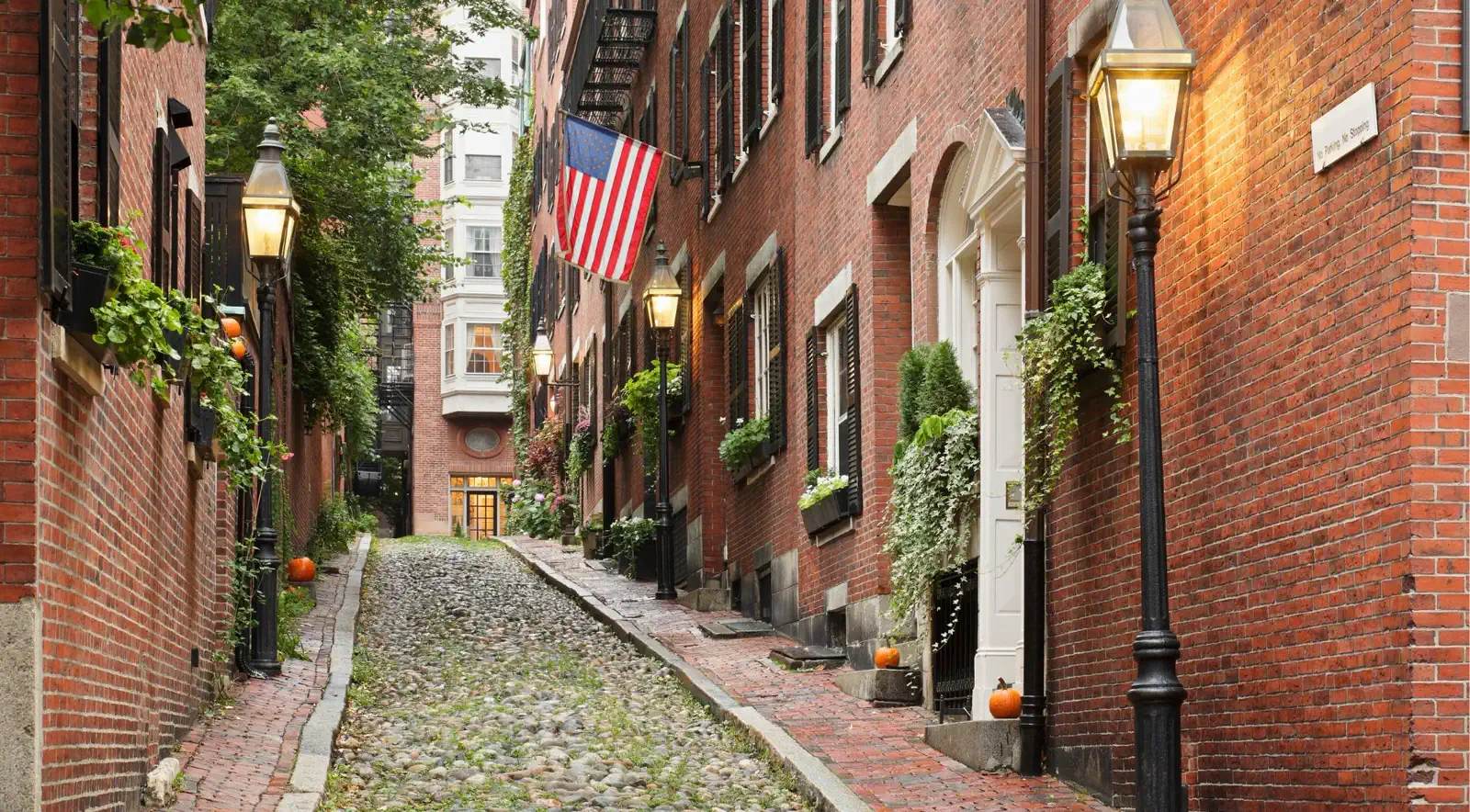
- 1630North End — Boston's oldest continuously inhabited neighbourhood
- 1680Paul Revere House — oldest remaining structure in downtown Boston
- $6Paul Revere House admission · Old North Church and Copp's Hill are free
- 2–2.5 hrSelf-guided loop including time inside the sites
- 1.2 milesTotal walking distance of the North End site loop
What the Poem Got Wrong — and Why the Real Story Is Better
Henry Wadsworth Longfellow published "Paul Revere's Ride" in 1861, 86 years after the events it describes, in the middle of the Civil War when a patriot myth was more useful than a complicated truth. Here is where it diverges from the documented record.
Revere did not row across the Charles alone
Two other men — Joshua Bentley and Thomas Richardson — rowed him across in a boat borrowed from a friend. A woman in a nearby house provided a petticoat to muffle the oars. The petticoat story is documented in Revere's own written account of the night, which survives in full.
The lanterns were a backup signal, not the starting gun
Revere arranged the signal with Robert Newman before he left — one lantern if the British marched by land, two if by sea (meaning via the Charles River). The signal was for Charlestown patriots across the water, to alert them in case Revere was intercepted. He nearly was — the patrol was waiting.
William Dawes rode too — and Longfellow rhymed him out of history
Dawes left Boston at roughly the same time as Revere by a different route, through the Roxbury gate. He reached Lexington and continued toward Concord before being turned back by a British patrol. He is almost entirely absent from popular history because Longfellow needed a rhyme and "Dawes" wasn't as useful as "Revere."
Samuel Prescott is the rider who reached Concord
When Revere and Dawes were intercepted by a British patrol outside Lexington, Prescott — a local doctor who had joined them at Lexington — jumped his horse over a stone wall and escaped through the fields. He reached Concord with the warning. Revere did not.
Revere was captured and walked home without his horse
The patrol held Revere for several hours before releasing him without his horse. He walked back to Lexington under guard, then independently. He arrived back around 3 AM and helped move John Hancock's papers before dawn. The improvisation under pressure — coordinating a multi-person operation, surviving capture, contributing without completing the mission — is a more interesting kind of heroism than a solitary midnight gallop.
Why Longfellow compressed the story
The poem was written in 1861, at the start of the Civil War, when the Union needed patriotic mythology more than historical accuracy. Longfellow chose Revere over Dawes and Prescott for metrical and rhyme reasons. The simplified version served its moment — it galvanised Northern readers. It also made a more complex human story invisible for 160 years.
Other Boston Experiences to Pair With the North End Walking Tour
Visitors who do the Paul Revere North End walking tour often pair it with one of these. Browse a hand-picked mix of the Ghosts & Gravestones after-hours graveyard tour at Copp's Hill and Granary, Boston's Freedom Trail walking tours, haunted pub crawls through the Freedom Trail tavern corridor, a Boston Harbor ghost cruise, Salem witch-trial day trips from Boston, and the North End food and history tour — with live availability and current prices below.
Paul Revere: The Five Careers the Poem Left Out
Paul Revere's midnight ride took approximately 2 hours. The rest of his life — from 1735 to 1818 — produced a career that most Americans have never encountered.
America's most significant colonial silversmith
Revere's silver work is considered among the finest produced in colonial America. Pieces attributed to him are held in the Museum of Fine Arts in Boston and several major American museums. His craft was the economic foundation that allowed him to pursue his political activities; the two were not separate. He took over his father's silversmith business at age 19 after his father's death and built it into one of the most respected craft businesses in colonial Boston.
The Boston Massacre engraving — plagiarism and political genius
Revere's most famous work is not his silversmithing. It is his 1770 engraving of the Boston Massacre — a piece of political propaganda that depicted British soldiers firing in a coordinated volley on an orderly crowd, with an officer appearing to give the command. The actual event was chaotic, the crowd was not orderly, and the soldiers were being pelted with ice and debris. The engraving was copied from a drawing by Henry Pelham, who accused Revere of plagiarism in a surviving letter. Revere's version circulated widely and shaped public opinion in ways the messy reality would not have.
America's first forensic dentist
Revere practiced dentistry as a sideline, making dentures from ivory and animal teeth. He is documented as one of the first Americans to use forensic dentistry: he identified the body of his friend General Joseph Warren after the Battle of Bunker Hill by recognising a dental bridge he had made for him. This is the first recorded instance of forensic dental identification in America. Warren is buried at Granary Burying Ground — a 20-minute walk from Revere's house.
The Penobscot Expedition — a catastrophic failure
The Penobscot Expedition of 1779 is the part of Revere's biography that does not appear in the poem. Revere commanded the artillery in an amphibious assault on a British naval position on the Maine coast. The expedition was a catastrophic failure: the fleet was destroyed, 43 ships lost, and survivors scattered into the wilderness to make their way back on foot. A court of inquiry initially found Revere guilty of disobedience and cowardice. He demanded a court martial to clear his name; the eventual verdict found him not guilty on all charges, but the cloud over his military reputation was never fully lifted.
America's first copper-rolling mill
After the Revolution, Revere established a copper rolling mill in Canton, Massachusetts — the first in America. The mill produced copper sheathing for the hull of the USS Constitution, the bolts for Boston's Beacon Hill State House dome, and copper for numerous other significant American projects. He died wealthy, industrially significant, and largely forgotten as anything other than a midnight rider. He is buried at Granary Burying Ground. See the Granary guide for what to look for at his grave.
A 83-year life reduced to 2 hours
Revere was born January 1, 1735. He died May 10, 1818, at age 83 — which means he lived to see the country he helped create through its first four presidents, the war with Britain he helped trigger, the industrial transformation of New England, and the slow disappearance of the colonial world he grew up in. The house at 19 North Square is where all of that started.
The Paul Revere North End Walking Loop: What to See and Why It Matters
Four sites within 1.2 miles of each other, covering colonial history, the Revolution, industrial disaster, and the point where the North End connects to Boston's ghost tour circuit.
-
Paul Revere House — 19 North Square
The oldest remaining structure in downtown Boston, built around 1680 — roughly 55 years before Revere was born. Revere purchased it in 1770 and lived there with his family until 1800. The house was subsequently used as commercial premises before falling into serious disrepair in the late 19th century; it was purchased and restored to its approximate 18th-century appearance in 1907 and opened as a museum in 1908. The interior has been furnished to reflect the Revere family's occupation. The house is small by any standard — a reminder that the revolutionary period's most celebrated figures were not wealthy by modern measures. Revere had 16 children by two wives; the house on North Square accommodated the family through the Revolution. The kitchen on the ground floor contains the large hearth central to colonial domestic life. The courtyard between the Revere house and the adjoining Pierce-Hichborn House (owned by Revere's cousin, open separately) provides context for the density of colonial North End settlement. Allow 30–45 minutes. Admission: $6 adult. Hours: daily 9:30 AM–5:15 PM April–October, reduced November–March. T: Haymarket (Green/Orange), 10-minute walk.
-
Old North Church — 193 Salem Street
Built in 1723 — the oldest standing church building in Boston and an Anglican (Church of England) church. The historical irony is that the signal for the patriot ride was hung in the steeple of a Tory congregation's place of worship by a church employee acting against the sympathies of most of his congregation. Robert Newman, the church sexton, climbed the steeple on the night of April 18, 1775, and hung two lanterns — the "two if by sea" signal. He was spotted, fled, hid overnight, and was later arrested by the British. He was released for lack of evidence. Newman's house still stands at 523 Salem Street, a short walk from the church. The box pews — private, enclosed seating areas that congregants rented and furnished — are original to the 18th century. The bells in the tower are among the oldest in America still rung regularly; Revere rang them as a teenager before his political activities made the loyalist congregation uncomfortable with him. Beneath Old North Church are burial crypts holding approximately 1,100 bodies interred between 1723 and 1860, included in behind-the-scenes tours. Allow 20–30 minutes. Free entry; behind-the-scenes crypt tour available separately. T: Haymarket (Green/Orange).
-
Copp's Hill Burying Ground — Hull Street (3 minutes from Old North Church)
Three minutes' walk from Old North Church and the natural final stop on any North End colonial walking tour — and the point where the colonial and ghost tour narratives converge most clearly. Cotton Mather, whose intellectual work helped make the Salem witch trials possible, is buried here in an unmarked location. The New Guinea section on the northern slope holds over 1,000 Black Bostonians buried from the late 17th century onward, many in simple fieldstone graves — among the oldest documented Black burial sites in America. The Malcom gravestone still bears three musket-ball impact marks from British soldiers using it for target practice during the occupation of 1768–1776. Captain Daniel Malcom's epitaph reads "a true son of liberty, a friend to the publick, an enemy to oppression." The soldiers who used his gravestone for target practice presumably disagreed. Copp's Hill is an official Freedom Trail site and one of the two on-foot stops on the Ghosts & Gravestones trolley tour. Full guide to Copp's Hill and all four historic burying grounds → Allow 20–30 minutes. Free. Open daily 9 AM–5 PM.
-
Great Molasses Flood Site — 529 Commercial Street (8 minutes from Copp's Hill)
On January 15, 1919, a storage tank containing approximately 2.3 million gallons of molasses collapsed on Commercial Street in the North End. The resulting wave — estimated at 25 feet high and moving at 35 miles per hour — swept through the neighbourhood, destroying buildings, crushing an elevated railway support column, and killing 21 people. Another 150 were injured. The molasses was being processed for industrial alcohol. The tank had been built hastily in 1915 and had leaked from the beginning; residents had been collecting molasses from the seam leaks. The company had ignored warnings for years. The subsequent investigation forced changes to building codes and inspection requirements that became standard practice nationally. Locals reported smelling molasses in the neighbourhood on hot summer days for decades afterward. The site is now a community baseball field and playground at 529 Commercial Street. A small historical plaque marks it. It is within a five-minute walk of Paul Revere's house — one of the North End's most unusual documented disasters, and not on the official Freedom Trail. Allow 10 minutes.
Boston's Freedom Trail: A Revolutionary Walking Tour
The most-reviewed Freedom Trail walking tour on GetYourGuide and the strongest option for visitors who want to cover the colonial and Revolutionary history of the North End and downtown Boston in a single 90-minute walk. The guide covers Paul Revere, Old North Church, the events of April 18–19, 1775, and the broader Freedom Trail narrative through Granary Burying Ground, the Old State House, and Faneuil Hall. At $31 with more than 2,000 reviews at a 4.5-star rating, it delivers exceptional value and consistent quality.
- 2,000+ verified reviews at 4.5★ — the most-reviewed Freedom Trail tour available
- Covers Paul Revere House area, Old North Church and the revolutionary narrative
- Includes Granary Burying Ground, the Old State House and Faneuil Hall
- ~90 minutes — fits naturally as a morning or afternoon walk before the evening ghost tour
- Free cancellation up to 24 hours before
The recommended full Boston day: this walking tour in the morning or afternoon, covering the Freedom Trail and North End colonial history by daylight → Granary and Copp's Hill burying grounds on foot at dusk → Ghosts & Gravestones trolley after dark for after-hours access to both burying grounds. That sequence covers more documented history per day than almost any other itinerary in Boston.
Boston: Official Freedom Trail® Tour
The Freedom Trail Foundation's official costumed guide tour is the most accessible way to cover the colonial history of the North End in context and the most affordable guided option at $18. The tour covers the full downtown Freedom Trail before reaching the North End, giving the Paul Revere sites their proper revolutionary context. The 90-minute format covers 11 of the 16 official Freedom Trail sites. The limitation is depth — 90 minutes across 11 sites means approximately 8 minutes per stop, so the North End sites get broader treatment than a dedicated North End tour provides. For first-time visitors who want an overview before going deeper, it's the right starting point.
- Official Freedom Trail Foundation tour — the lowest-price guided option at $18
- Costumed guide adds theatrical context to the colonial narrative
- Covers 11 of 16 Freedom Trail sites in 90 minutes
- Strong overview before returning to individual sites independently
- Free cancellation up to 24 hours before
Best used as a first pass through the trail: take this tour in the morning to orient yourself, then return to Paul Revere House, Old North Church and Copp's Hill in the afternoon with the fuller context you've gained. Combine with the Freedom Trail tours guide for a complete picture of all 16 sites.
Three Layers of Dark History in Boston's Oldest Neighbourhood
The North End's documented dark history runs from colonial execution grounds through industrial disaster to organised crime and beyond. Here is the record behind the neighbourhood's reputation.
The Great Molasses Flood: 2.3 million gallons at 35 mph
The Purity Distilling Company's molasses storage tank on Commercial Street had been leaking since it was built in 1915. Residents collected molasses from the seams and brought it home. On January 15, 1919, the tank — holding 2.3 million gallons — collapsed without warning. The resulting wave killed 21 people, injured 150 more, collapsed buildings and an elevated railway support column, and ran into Boston Harbour for months afterward. The cleanup took weeks. The disaster prompted new building inspection requirements and structural engineering standards. The site is now a playground at 529 Commercial Street.
Prohibition and the North End's underground drinking culture
The North End's Italian community maintained its drinking culture through Prohibition with a combination of home distillation, speakeasy operations, and selective enforcement. Several of the neighbourhood's current restaurants and bars are in buildings with Prohibition-era histories their operators acknowledge informally. The North End's density — narrow streets, tight community bonds, front rooms that could be closed quickly — made it one of the city's most effective zones for underground drinking operations. The same density that made revolutionary conspiracies easy in the 1770s made Prohibition evasion practical in the 1920s.
The North End's changing communities and persistent history
The North End was Boston's Jewish neighbourhood before it was Boston's Italian neighbourhood — and before that, its Irish neighbourhood, and before that, the English Puritan founding community. Each wave of immigrants brought their own culture and pushed out the previous one. The oldest structure — Paul Revere's house, built in 1680 — predates all of these communities. The neighbourhood's current Italian character dates to the 1880s; by 1920 it was the most densely Italian neighbourhood in New England. Today it is gentrified but retains the density, intimacy and food culture that most of downtown Boston has lost to development.
Cotton Mather, Old North Church and the Salem connection
Cotton Mather — the Puritan minister who attended the Salem witch trial executions and wrote the texts that helped make them possible — rang the bells at Old North Church as a teenager, decades before Robert Newman hung the lanterns in the same steeple. Mather is buried at Copp's Hill in an unmarked grave. The overlap between the colonial church that triggered the Revolution and the minister who triggered the Salem trials is uncomfortable and exact: the same building, the same neighbourhood, the same documented community. The connection between the North End's colonial history and the Salem witch trials runs through the streets you walk on the Revere tour.
End the Day with the Ghosts & Gravestones Trolley Tour
The Paul Revere walking tour and the Boston ghost tour circuit converge at two specific points. Copp's Hill Burying Ground is both the natural endpoint of the North End colonial loop and one of the two on-foot stops on the Ghosts & Gravestones trolley tour — visiting it by day as part of the Revere tour gives you the Malcom gravestone, the New Guinea section, and the layout, so the evening ghost tour stop is much richer. Granary Burying Ground, where Paul Revere is buried, is the trolley tour's other on-foot stop — the connection between Revere's house and his grave threads through both itineraries. The Ghosts & Gravestones trolley departs Long Wharf, a 20-minute walk from the North End.
- After-hours on-foot access to Copp's Hill (North End) and Granary Burying Ground (downtown)
- After visiting both by day, the evening ghost tour stop is qualitatively different
- Costumed gravedigger host with historically grounded colonial narration
- Departs Long Wharf — 20-minute walk from the North End
- Free cancellation up to 24 hours before; October dates sell out early
The recommended full Boston day: the Revolutionary Walking Tour in the morning → Paul Revere House and Old North Church independently → Copp's Hill by late afternoon → Ghosts & Gravestones trolley after dark. That sequence visits Copp's Hill twice — once for the colonial history and once for the after-hours ghost tour — and gives you the deepest possible reading of the same ground. Full burying grounds guide →
North End Visiting Tips: Getting There, Best Times and What to Build In
Everything you need to visit the North End loop efficiently — transport, crowds, food and how to connect it to the rest of your Boston day.
Getting to the North End
The most practical T stops are Haymarket (Green and Orange Lines) and Aquarium (Blue Line), both within a 10–15 minute walk of Paul Revere House at 19 North Square. Parking in the North End is extremely limited and not recommended — the neighbourhood was built before cars and its streets reflect this. The T is the right answer.
Best time to visit
Weekday mornings from Tuesday through Thursday offer the smallest crowds at Paul Revere House and Old North Church. Summer weekends are busy but manageable. October weekends bring Freedom Trail crowds that extend into the North End. The North End is at its most atmospheric in the early morning — arrive at Paul Revere House at opening (9:30 AM) and you may have it nearly to yourself.
Eating in the North End
Build in time for food. Mike's Pastry (300 Hanover Street) and Modern Pastry (257 Hanover Street) are the two poles of the great North End cannoli debate — locals are passionate partisans of one or the other. Neptune Oyster (63 Salem Street) is one of the best seafood restaurants in Boston and books out weeks in advance for dinner. Giacomo's (355 Hanover Street) is the neighbourhood's most famous pasta restaurant and operates a no-reservations, cash-only policy that produces a queue down the street most evenings.
How long to allow
A minimum half-day for the North End loop: 2–2.5 hours for the sites, plus time for food. If you're doing the Revere loop as part of a full Freedom Trail walk, allow a full day. The Ghosts & Gravestones trolley departs Long Wharf at approximately 20-minute walk from the North End, making the day-to-evening sequence straightforward.
Site admission summary
Paul Revere House: $6 adult, $5 senior/student, $1 children 5–17, free under 5. Open daily 9:30 AM–5:15 PM (April–October); reduced hours November–March. Old North Church: free entry; behind-the-scenes crypt tour available separately. Copp's Hill: free, open 9 AM–5 PM daily. Molasses Flood site: free, outdoor plaque at 529 Commercial Street.
The recommended full-day sequence
Morning: Official Freedom Trail Tour (90 min, covers downtown and North End in context). Late morning: Paul Revere House and Old North Church independently (~1.5 hrs). Afternoon: Copp's Hill Burying Ground and the Molasses Flood site (~40 min). Dinner in the North End. Evening: Ghosts & Gravestones trolley from Long Wharf for after-hours access to Copp's Hill and Granary — covering the same ground at night that you walked by day.
Paul Revere & the North End: Common Questions Answered
The midnight ride, site hours, the molasses flood and how the North End connects to Boston's ghost tours — answered before you go.
Did Paul Revere actually complete his midnight ride?
No. Revere was captured by a British patrol outside Lexington and never reached Concord. Samuel Prescott, a local doctor who had joined Revere and William Dawes en route, was the rider who actually reached Concord with the warning. Revere was held for several hours before being released without his horse; he walked back to Lexington and helped move John Hancock's papers before dawn. Longfellow's 1861 poem simplified and compressed the events significantly for effect.
Where is the Paul Revere House?
19 North Square, Boston, in the North End neighbourhood. The nearest T stop is Haymarket (Green/Orange Line), approximately a 10-minute walk. Hours are daily 9:30 AM to 5:15 PM from April through October, with reduced hours from November through March. Admission is $6 for adults.
Is Paul Revere buried in the North End?
No. Paul Revere is buried at Granary Burying Ground on Tremont Street in downtown Boston — about a 20-minute walk from his house in the North End. Granary is an official Freedom Trail site and one of the two on-foot stops on the Ghosts & Gravestones ghost trolley tour. See our complete guide to Boston's haunted graveyards for visiting hours and what to look for at Granary.
Who hung the lanterns in Old North Church?
Robert Newman, the church sexton. He hung two lanterns — the "two if by sea" signal — in the steeple window facing Charlestown on the night of April 18, 1775, as a backup signal in case Paul Revere was intercepted leaving Boston. Newman was later arrested by the British but released for lack of evidence. Newman's house still stands at 523 Salem Street, a short walk from the church.
What happened in the Great Molasses Flood?
On January 15, 1919, a storage tank holding 2.3 million gallons of molasses collapsed on Commercial Street in the North End, sending a wave of molasses through the neighbourhood that killed 21 people and injured 150 more. The cleanup took weeks; Boston Harbour ran brown for months. The site is now a playground at 529 Commercial Street. A historical plaque marks it.
How long does the Paul Revere North End walking tour take?
A self-guided loop covering Paul Revere House, Old North Church, Copp's Hill Burying Ground, and the Great Molasses Flood site takes approximately 2–2.5 hours including time inside the sites. A guided tour runs 90 minutes. Build in extra time for food — the North End's Italian bakeries and restaurants are worth it.
How does the North End connect to Boston's ghost tours?
Copp's Hill Burying Ground is both the natural endpoint of the North End colonial walking tour and one of the two on-foot stops on the Ghosts & Gravestones trolley tour. Visiting it by day as part of the Revere tour gives context — the Malcom gravestone with musket-ball damage, the New Guinea section, the layout — that makes the evening ghost tour stop significantly richer. Granary Burying Ground, where Paul Revere is buried, is the other on-foot ghost tour stop and a 20-minute walk from the North End. See our full Boston ghost tours guide for all formats.